Dressing Guide for People Who Get Cold Easily
Same temperature, so why am I the only one shivering — accepting the difference in perception and correcting by one tier is the answer.
Seoul, 12°C on an April morning. One person boards the subway in a thin shirt and cardigan, while the person next to them stands with arms folded even in a light puffer at the same temperature. Neither is wrong — their bodies are simply different. Thermoregulation, peripheral circulation, body fat percentage, and muscle mass vary quite a bit from person to person. Being sensitive to the cold isn't about having a fussy personality; it's a difference in physiology and constitution.
See today's recommendation tuned to your sensitivity in WearCast →
Why generic weather-app recommendations don't fit you
Most weather outfit apps end with a single line: "15°C today, try a thin knit." That recommendation assumes an average body in an average situation. Three problems follow.
- The reference is air temperature, not felt temperature — a number that strips out wind and humidity
- No adjustment for individual difference — peripheral circulation, body fat, muscle mass, even medications all matter
- Based on the current reading, not the day's low — morning and evening temperatures can differ by 5–8°C, but you have to make it through in one outfit
What a cold-sensitive person needs isn't "what does the average person wear today" but "what do I need to wear today so I'm not shivering." Those two questions demand completely different answers.
The +1 tier correction formula
The simplest method, battle-tested in the real world, is to look at today's temperature as if it's one tier lower. If today's temperature is 15°C, a cold-sensitive person dresses for 10°C instead. Five-degree bands are a natural interval for everyday dressing rules, which makes "drop by one tier" the fastest mental adjustment.
| Actual temp | Standard recommendation | Cold-sensitive (+1 tier) |
|---|---|---|
| 20°C | Long-sleeve shirt | Long-sleeve + light cardigan |
| 15°C | Cardigan, thin knit | Knit + light jacket |
| 10°C | Trench, light jacket | Trench + heat-tech base layer |
| 5°C | Coat | Coat + knit + light puffer vest |
| 0°C | Puffer jacket | Puffer + thermal underwear + scarf |
| -5°C | Thick long puffer | Long puffer + 2 base layers + gloves |
This table is a starting point, not an absolute. On windy days drop one more tier; if you'll be mostly indoors, bump it up half a tier.
The 3-check daily routine
Most regrets about outfit choices come from trying to save five minutes in the morning. Check these three times instead and misfires almost disappear.
1. Thirty minutes before leaving — check the apparent temperature
Don't look at the air temperature — check the apparent temperature first, then apply the +1 tier formula. On windy days the felt temperature runs noticeably lower than the reading.
2. Right before stepping out — the fingertip and toe test
Stand still for 30 seconds indoors and check whether your fingertips feel cold. If they do, add one layer — a heat-tech base or a thin set of long underwear. If your home is near 20°C indoors and your fingers are already cold, it'll be worse outside.
3. Recheck the afternoon peak
If the forecast high in the warmest part of the day (usually 1–4 PM) is more than 10°C above the morning reading, switch to a combination with an outer layer you can take off and carry. The difference in a day's comfort between "outerwear you can remove" and "no option to remove" is significant.
The dual-sensitivity mindset
People sensitive to cold and people sensitive to heat need to correct in opposite directions. Most apps only offer a single sensitivity toggle, which leaves cold-sensitive people overheated in summer or heat-sensitive people underdressed in winter. WearCast takes cold sensitivity and heat sensitivity as two independent values. That way someone who's "very cold-sensitive but average in summer" gets different calculations across the seasons. Two sliders on one screen, adjusted once in onboarding, and from then on it applies automatically.
Traps people keep falling into
- Dressing to indoor heating — matching your outfit to a 25°C office means suffering for an hour on the commute. The reference is outdoor morning low
- Dressing thin for the afternoon high — it's common in shoulder seasons for the morning-to-afternoon swing to reach 10°C
- "I'll warm up fast from exercise, it's fine" — cold-sensitive people tend to feel discomfort quickly once sweat cools. A change of clothes after a workout isn't optional
- Material and thickness beat color — warmth comes mostly from fiber type and the structure of trapped air. Merino wool, PrimaLoft, and down are the go-to warm materials
How we solve this
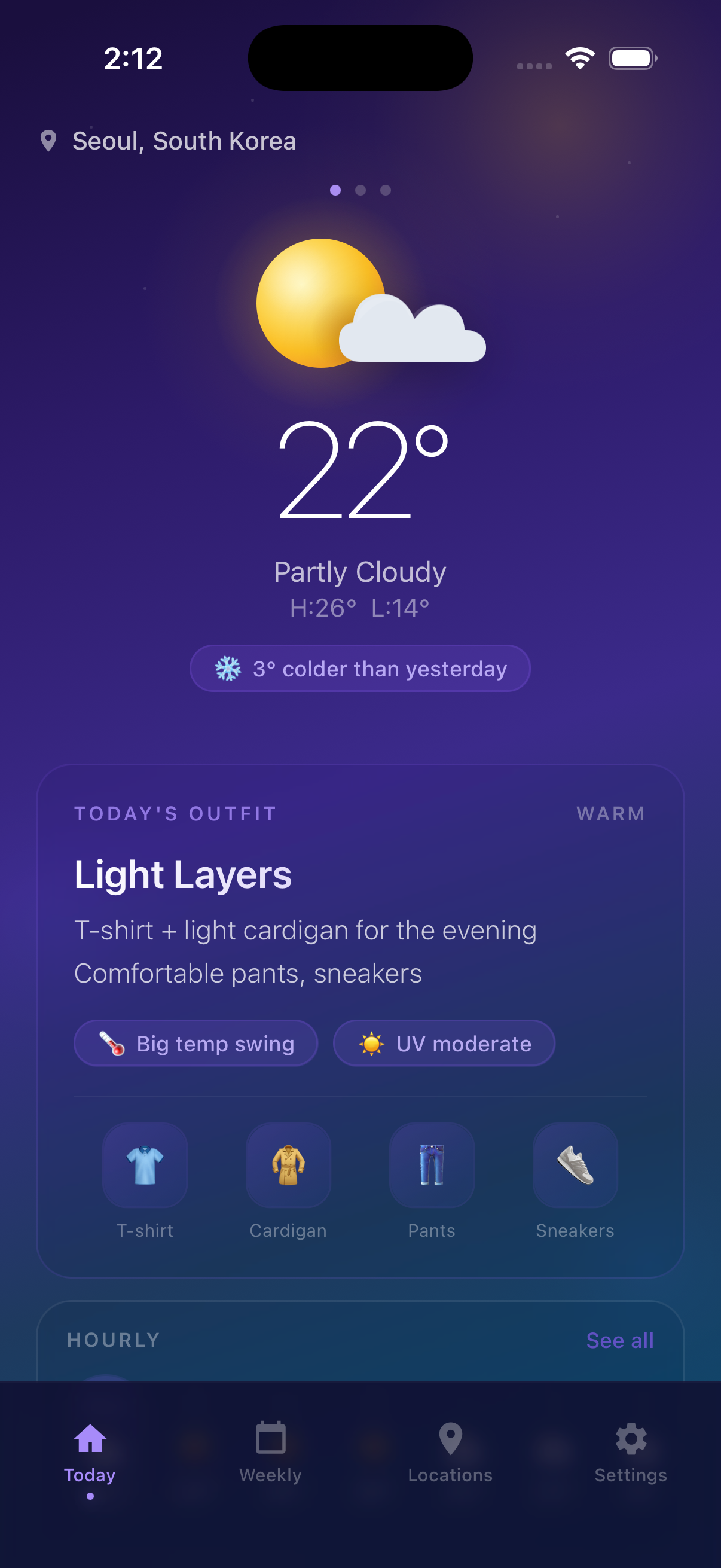
WearCast takes your cold sensitivity and heat sensitivity as two separate 5-step sliders during onboarding, pulls today's live apparent temperature, wind, and humidity from Open-Meteo, and applies the +1 tier formula above automatically. Pick one of six activity modes — commute, run, walk, hike, bike, or school — with a single tap, and a single recommendation tuned for dual sensitivity lands on your home screen. Not "pick one of three" — just "wear this today."
FAQ
Q. Should cold-sensitive people always dress one tier warmer? A. The default is a +1 tier adjustment, but if you're indoors a lot or mixing in heat-generating activity (brisk walking, cycling), one tier less can actually be better. The key is to dress to the outdoor temperature at the moment you leave, then pick outerwear you can peel off as temperatures rise. If you'll be outside for an hour or more, keep the +1 tier; for 30 minutes or less, just a half tier up is enough.
Q. Does cold sensitivity shift with age? A. Yes — peripheral circulation and basal metabolism gradually change with age. It's common for someone who was "average" in their late 20s to drift into "slightly cold-sensitive" by their early 40s. Re-tuning your sensitivity periodically in an app like WearCast helps catch that drift.
Q. What if I'm sensitive to both heat and cold at the same temperature? A. It's not rare at all. It shows up in people with sensitive autonomic regulation and tends to appear as a weak reaction to the sharp swings between air-conditioned rooms and hot outdoor air in summer. The answer is to keep your base outfit light but always bring one easy-to-remove layer like a cardigan or a thin scarf. WearCast's dual-sensitivity feature exists exactly for this — cold and heat sensitivity are taken separately.
Related guides
- Shoulder-season outfit mastery — tier-based picks with sensitivity tuning — the parent guide to this +1 tier formula
- What to wear at -5°C — extreme cold outfit formula — the toughest tier for cold-sensitive people
- Hiking outfits by temperature — spring/fall and winter layering — the advanced version with activity-mode adjustment
- What to wear today? Weather-outfit apps compared — apps that offer sensitivity tuning