Cold Sensitive Outfit Recommendations — A Year-Round Framework
Generic outfit advice is built for the median body. If that is not your body, the advice is wrong half the year and exhausting the other half. This framework is for cold sensitive people who run cold.
If you have ever followed a "what to wear at 60°F" article to the letter and still arrived at your destination chilled through, the problem is not that you misread the advice. The advice was written for someone else. Bodies differ in circulation, body composition, muscle mass, and metabolic output, and plenty of people feel meaningfully colder than average in the same room. Some of that comes from straightforward variables — body fat distribution, muscle mass, hormones — and some from medical conditions like Raynaud's phenomenon, hypothyroidism, or anemia that affect peripheral blood flow (Mayo Clinic). Whatever the source, generic outfit recommendations were not designed with your body in mind. This guide is a framework for building outfit decisions that are.
Tell WearCast how cold you run and get personalized picks →
Why "just put on a sweater" does not work
Three specific ways generic advice tends to fail cold-sensitive readers:
Single-axis sensitivity assumption. Most weather outfit tools and articles ask you to pick "do you run hot or cold?" — assuming that cold and heat sensitivity are opposite ends of the same spectrum. They are not. Many cold-sensitive people are perfectly comfortable in summer. Forcing one preference for both halves of the year is wrong half the year.
Temperature-only recommendations. Wind and humidity affect cold-sensitive bodies disproportionately. Wind strips the layer of warm air that your body has built up around itself, and damp air pulls heat away faster than dry air. A "60°F outfit" recommendation that ignores wind and humidity will mislead you on any day that is not still and dry.
Assumed activity levels. A 5-minute walk to a heated car is a completely different problem from a 25-minute outdoor commute. Generic articles often skip activity entirely, which means the same outfit shows up for "running outdoors" and "waiting for the bus."
The framework below addresses all three.
The three-part framework
Part 1: Shift your baseline
When you read any outfit recommendation, treat the stated temperature as if it were one zone colder, and dress for that zone instead. So a "light jacket at 55°F" recommendation becomes "what would I wear at 50°F?" for you. A "wear a coat at 40°F" becomes "what would I wear at 35°F?"
This single adjustment resolves most "everyone else is fine and I'm cold" situations across the year. It is not a fix — it is a translation layer between advice that was written for the median body and advice that fits yours. The detailed temperature-by-temperature guidance is in how to layer clothes for cold weather, which uses the median body as a reference point that you can shift down by one zone.
Part 2: Prioritize the edges
Cold-sensitive people often feel cold first in the extremities — hands, feet, neck, and head — and these areas are also the most vulnerable to frostbite (CDC). The intuitive response is to put on a thicker sweater, but a thicker sweater warms the part of your body that is already warmest. The actually effective response is to insulate the areas that lose heat or feel cold first.
| Priority | Body area | Most useful items |
|---|---|---|
| 1 | Hands | Thin liner gloves (merino or silk) under outer gloves; convertible mittens for variable conditions |
| 2 | Feet | Wool socks (not cotton); insulated insoles for prolonged outdoor stints |
| 3 | Neck | Light scarf year-round; merino buff for variable conditions |
| 4 | Head | Beanie at any temperature below 50°F if you are cold-sensitive |
| 5 | Lower back | Tucked-in base layer prevents the wind-tunnel effect that chills the kidneys and lower back |
A useful rule of thumb: if your hands feel cold first, insulate hands first. If your feet feel cold first, insulate feet first. The order varies between individuals, and the right priority is the one that maps to your body's actual cold-loss pattern.
Part 3: Adjust dynamically
Static outfits work for static days. Most days are not static — temperature shifts from morning to afternoon, you move between heated indoor spaces and cold outdoor ones, and wind changes during your commute.
Three rules that hold across the year:
- Plan for the morning low, not the daytime high — if the day starts at 35°F and peaks at 55°F, dress for 35°F with a removable outer layer. Cold-sensitive bodies do not warm up as quickly as average bodies, so the morning chill lasts longer
- Use feels-like temperature, not the thermometer — wind and humidity matter more for cold-sensitive bodies. By the standard NWS wind-chill formula, a 50°F day with 15 mph wind feels closer to the mid-40s, and may feel colder still if you run cold
- Always have a packable layer in your bag — a thin merino long-sleeve or a packable down vest weighs almost nothing and rescues you when conditions shift unexpectedly
The dynamic rules are where personalization apps add the most value. A static recommendation cannot account for "the wind picked up at 3 PM." An app that pulls live conditions can.
Year-round application — by season
The framework works the same way in any season, but the pieces shift.
Autumn (50-65°F). Most generic advice says light jacket weather. For cold-sensitive bodies, this is the season where a long-sleeve merino base under a sweater becomes daily wear. Add a wind-resistant outer layer for breezy days. The detailed 50°F adjustment is in how to dress for 50 degree weather.
Winter (below 40°F). The three-layer system from the layering guide applies, with the cold-sensitive adjustments: thicken the base layer first, then add a thin mid layer underneath rather than a heavier outer layer. Insulated boots and wool socks become non-negotiable.
Spring (45-60°F). The most variable season for cold-sensitive bodies. Mornings are still cold; afternoons can be mild. A removable mid layer is the most useful piece in the wardrobe. Keep the autumn base layers in rotation longer than average-sensitivity people typically would.
Summer (above 70°F). Many cold-sensitive people are comfortable in heat, so summer is often the easiest season. The exception is heavily air-conditioned indoor spaces — offices, planes, restaurants — where a light cardigan or scarf is worth carrying year-round.
Common mistakes cold-sensitive people make
- Following generic outfit articles as if they applied — they were written for the median body, not yours
- Adding bulk to the core when extremities are losing heat — a thicker sweater does not help if your hands are cold
- Wearing cotton base layers — cotton holds sweat and turns cold; merino or synthetic performance fabrics are worth the upgrade for cold-sensitive bodies
- Underdressing in mild conditions — 60°F looks like t-shirt weather to many people but is jacket weather for cold-sensitive bodies
- Ignoring wind — a 50°F day with 15 mph wind feels closer to the mid-40s by standard wind-chill calculations, and cold-sensitive bodies feel that difference more than average
- Overdressing in summer because winter dressing was hard — summer comfort range can be entirely different and does not need cold-weather habits applied
How WearCast handles cold-sensitive bodies
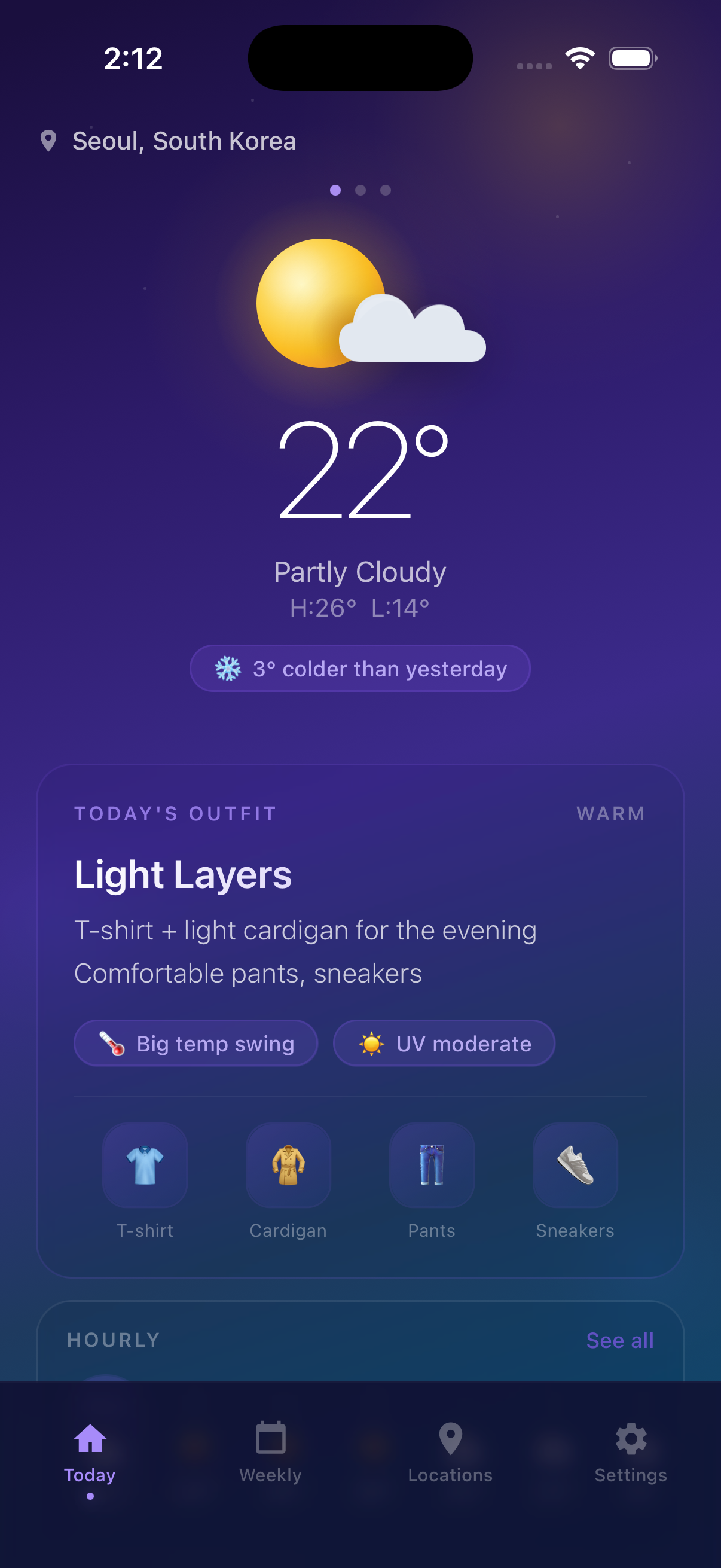
WearCast asks for cold sensitivity and heat sensitivity as two separate sliders during a 30-second onboarding. From there, it pulls live feels-like temperature from Open-Meteo (factoring wind and humidity, not just the thermometer), applies your personal profile, and produces a single outfit card per day. The recommendation already includes the baseline shift from Part 1, the extremity priority from Part 2, and the dynamic adjustments from Part 3 — without the lookup work. You pick an activity for the day with one tap (commute, running, walking, hiking, cycling, or school), and the outfit adjusts for that activity too.
The dual-sensitivity model is the key difference from generic weather outfit apps. A more detailed comparison of the categories is in what to wear weather apps in 2026.
FAQ
Q. How do I know if I am genuinely cold-sensitive or just underdressed? A. The simplest signal is whether you regularly disagree with generic forecast app recommendations. If "light jacket weather" leaves you shivering after 10 minutes, your sensitivity is meaningfully different from the median. Another check: in the same indoor temperature, are you reaching for a sweater while others are reaching for a t-shirt? Pattern matching across multiple days is more reliable than any single morning.
Q. Are there medical conditions that increase cold sensitivity? A. Yes. Mayo Clinic identifies several conditions that affect peripheral blood flow or heat regulation, including Raynaud's phenomenon, hypothyroidism, and anemia; other circulation-related conditions may also contribute. If your cold sensitivity is sudden, unilateral (one side of the body), or accompanied by other symptoms, a medical conversation is worthwhile. Most cold sensitivity, however, is simply individual variation in body composition and circulation, and is not a medical issue.
Q. Should I just always overdress to be safe? A. No, because cold-sensitive bodies are not necessarily heat-tolerant. Many cold-sensitive people overheat quickly when they overdress and then sweat into base layers, which makes the rest of the day worse. The framework above is built around removable layers specifically so that you can adjust as conditions and exertion change.
Q. Does the framework work for kids? A. With one adjustment. Kids lose body heat faster than adults because of a higher surface-area-to-mass ratio, so they generally need one extra layer compared to a same-sensitivity adult. But kids also move more, so the extra layer should be removable. The extremity priorities from Part 2 apply identically.
Q. Is there a single most useful purchase for a cold sensitive person? A. A heavyweight merino base layer for cold-weather days is the highest-impact cold sensitive outfit recommendations purchase. It addresses the baseline shift (Part 1) and the core warmth question without adding bulk, and it works under almost any outer layer. Wool socks are a close second.
Related guides
- How to Dress for 50 Degree Weather — applying the framework to a specific temperature
- How to Layer Clothes for Cold Weather — the three-layer system as a foundation
- What to Wear Weather Apps in 2026 — the tools that respect dual sensitivity