How to Dress for 50 Degree Weather (Your Sensitivity Changes Everything)
50°F (10°C) is the most misread temperature on American weather apps. It feels like a light jacket day on paper and a full coat day to anyone who runs cold.
At 50°F, half of your coworkers will walk into the office in a cardigan and the other half in a wool coat. Neither group is wrong. Circulation, metabolism, body fat distribution, and muscle mass vary meaningfully from person to person, and anyone with reduced peripheral circulation loses heat from their hands and feet much faster than average in the same outdoor conditions. The "how to dress for 50 degree weather" question has no single correct answer — it has a correct answer for your body. This guide gives you a specific layering formula you can adjust once and reuse.
Skip the reading and let WearCast pick your 50°F outfit →
What 50°F actually feels like
Before we talk about clothes, notice that 50°F isn't always 50°F. The perceived temperature (your weather app calls it "feels like") depends on three things besides the thermometer:
- Wind — a breezy 50°F feels considerably colder than a still 50°F
- Humidity — damp 50°F often feels colder in practice, but "feels-like" formulas vary by provider. At cool temperatures, wind is the most consistently important factor, and some apparent-temperature models also include humidity and sun
- Sun exposure — direct sun adds noticeable warmth, shade takes it away
A calm, dry, sunny 50°F morning feels warmer than a windy, overcast, damp 50°F evening. Before picking layers, check the feels-like number your weather app shows, not just the thermometer.
The base layering formula for 50°F
Here's the standard outfit for an average-sensitivity adult on a neutral 50°F day:
- Base layer: long-sleeve t-shirt or light merino top
- Mid layer: light sweater, cardigan, or button-up shirt
- Outer layer: light jacket, denim jacket, trench, or a thin wool coat
- Bottom: chinos, jeans, or midweight trousers
- Accessories: optional light scarf, no gloves yet
This is the template. The next two sections tell you how to shift it up or down based on your body.
If you run cold at 50°F
If you're someone who gets cold at this temperature while others are comfortable, treat the day as if it were 45°F and dress accordingly. A useful shorthand is the +1 layer rule: add one piece that lives between your base and outer layer, or thicken the base layer itself.
Practical swaps:
- Long-sleeve t-shirt → thin merino long-sleeve or a thermal base
- Cardigan alone → cardigan under a light jacket
- Ankle socks → wool crew socks
- Bare hands → thin liner gloves in your pocket, ready if your fingers start to ache
Cold-sensitive people typically feel the difference most in their hands, feet, and lower back. Prioritizing those areas often delivers more comfort per added layer than piling extra bulk on the core. The detailed framework is in our cold-sensitive outfit recommendations guide.
If you run warm at 50°F
At 50°F, people who run warm often overdress based on conventional advice and end up peeling layers all morning. Instead, take the base template and subtract:
- Drop the sweater, keep the long-sleeve base
- Swap the wool coat for a denim jacket or a light windbreaker
- Skip the scarf entirely
- If you'll be walking briskly, assume your body will warm up quickly once you're moving
Heat-sensitive people at 50°F should think of the temperature as if it were a few degrees warmer. That single shift usually resolves the "overheated by 9 AM" problem.
Outfit ideas by situation
Commuting to an office (indoor temp ~70°F)
- Long-sleeve shirt + light sweater + trench coat + chinos
- Coat and sweater both removable indoors, leaving a work-appropriate shirt
Walking or running outdoor errands
- Merino long-sleeve + light windbreaker (wind matters more than cold at 50°F while moving)
- Leggings or joggers + full-length socks
- Light beanie if it's windy
Workout outdoors (running, cycling)
At 50°F with movement, your body warms up quickly. Overdressing is the most common mistake runners make. A useful rule of thumb: dress as if it were meaningfully warmer than it is — the first few minutes feel chilly, then you're comfortable. A long-sleeve performance top + shorts or thin tights usually covers it, with thin gloves you can stash in a pocket.
Weekend casual
- Denim jacket + long-sleeve tee + jeans
- Or: cardigan + button-up shirt + chinos
- Low stakes, easy to add a scarf if you feel the chill
Common mistakes at 50°F
- Dressing for the midday high instead of morning low — if the day starts at 50°F and peaks at 62°F, a heavy coat will be unbearable by noon. Pick a removable outer layer
- Ignoring wind — a stiff wind at 50°F can make it feel like a colder day entirely. A windbreaker does more work than adding another sweater
- Cotton base layers for any activity — cotton holds sweat and turns cold quickly. Merino or synthetic performance fabrics are worth the upgrade
- Assuming "light jacket weather" equals your best friend's light jacket weather — sensitivity is individual
Proper layering is its own topic — our how to layer clothes for cold weather guide covers the multi-layer mechanics in depth.
The dual-sensitivity idea
Most weather outfit apps offer a single "warm vs. cool" preference toggle, which forces every user into a one-dimensional choice. The reality is that some people are very cold-sensitive in winter but feel perfectly average in summer, and vice versa. Treating cold sensitivity and heat sensitivity as two independent axes is what actually matches how human bodies work. At 50°F, your cold sensitivity is doing most of the work, but at 85°F it's your heat sensitivity that takes over. A weather outfit app that only has one axis will nudge you in the wrong direction half the year.
How WearCast solves this
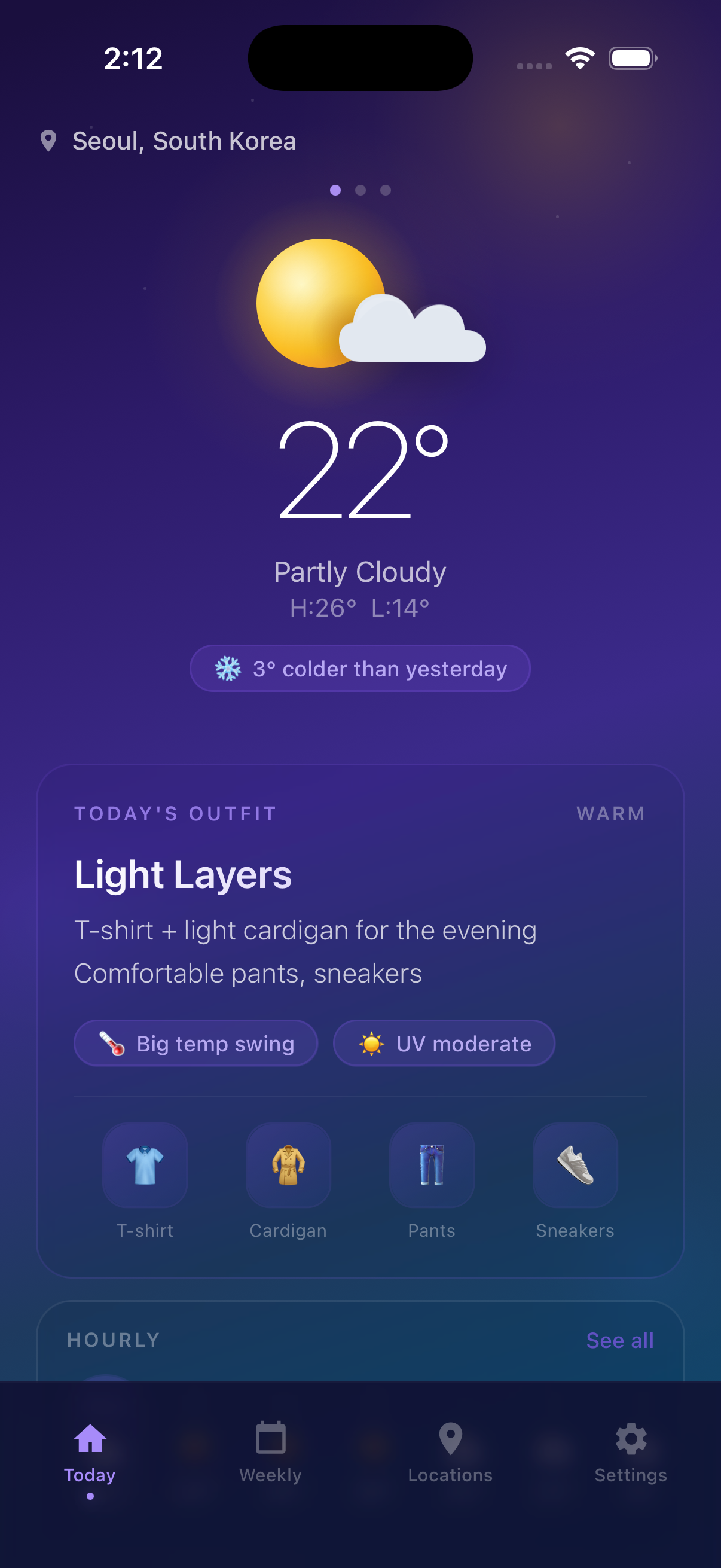
WearCast asks for your cold sensitivity and heat sensitivity separately in a short onboarding. From then on, it pulls the live feels-like temperature from Open-Meteo — including wind and humidity — and applies your personal profile to generate one outfit recommendation per day. You pick an activity mode (commute, running, walking, hiking, cycling, or school) with one tap. No wardrobe upload, no three-option menu. At 50°F, the app already knows whether to show you the cardigan day or the light coat day.
FAQ
Q. Is 50 degrees cold enough for a winter coat? A. For most people, no. A wool coat or heavy trench is more appropriate than a down parka at 50°F. The exception is if you run cold, will be standing still outdoors for an hour or more, or if it's especially windy. In those cases, a light down vest or a thicker wool overcoat makes sense. Save the real winter coat for much colder days.
Q. Should kids dress differently at 50 degrees? A. Yes, in two ways. Kids lose body heat faster than adults because of a higher surface-area-to-mass ratio, so they generally need one extra layer compared to a same-sensitivity adult. But kids also move more, so that extra layer should be removable. A long-sleeve base + a fleece midlayer + a light jacket gives the most flexibility. Always pack an extra t-shirt in case the base layer gets sweaty — wet cotton cools a child's core temperature surprisingly fast.
Q. What shoes work best at 50 degrees? A. Closed-toe sneakers or leather boots are the comfortable range. Canvas shoes work if it's dry and sunny, but they get cold quickly if there's any moisture. Ankle boots with a wool sock are a reliable default. Open shoes like sandals are technically fine at 50°F for heat-sensitive people on a sunny day, but most people find their feet get uncomfortably cold within 20 minutes of walking.
Q. Does 50°F feel different in humid vs. dry climates? A. Many people report that a damp, cool 50°F day feels colder than a dry one. Formulas vary: the US NOAA wind chill uses only temperature and wind, while some apparent-temperature models (like Open-Meteo's) also include humidity and sun. In practice it's safer to trust the feels-like number your weather app shows rather than the thermometer alone.
Related guides
- How to Layer Clothes for Cold Weather — By Cold Sensitivity Profile — the complete layering system
- Outfit Recommendations for Cold-Sensitive People — a personal framework
- Best 'What to Wear' Weather Apps in 2026 — Compared by a Daily User — tools to automate this